

New Jersey has some of the strictest gun laws in the country, and the Graves Act is the reason a single firearm arrest could mean years in state prison. A Graves Act conviction carries a mandatory period of parole ineligibility, which means the judge cannot simply impose probation, even for a first offense.
The good news is that mandatory does not always mean inevitable. Through a Graves waiver, many first-time offenders can avoid the full mandatory minimums. At Rigden Lieberman Mignogna, Alexandra (Lexie) Rigden, Esquire, knows how to build the case for a waiver and fight Graves Act charges from day one.
What Is the Graves Act?
The Graves Act, N.J.S.A. 2C:43-6(c), is New Jersey's mandatory minimum sentencing law for certain firearm offenses. The Graves Act was designed to deter gun violence.
Under the Graves Act, a judge who would otherwise have discretion over sentencing must impose a minimum term of parole ineligibility. That minimum applies regardless of a clean record, good character, or the circumstances that led to the arrest, unless a waiver is granted.
Which Offenses Are Graves Act Offenses?
The Graves Act covers two broad groups of crimes: certain firearm possession offenses and serious crimes committed while possessing or using a firearm.
Common Graves Act possession offenses include:
- Unlawful possession of a handgun without a permit (N.J.S.A. 2C:39-5(b)), the most frequently charged Graves offense.
- Unlawful possession of a rifle or shotgun (N.J.S.A. 2C:39-5(c)).
- Unlawful possession of an assault firearm (N.J.S.A. 2C:39-5(f)).
- Unlawful possession of a machine gun (N.J.S.A. 2C:39-5(a)).
- Possession of a firearm for an unlawful purpose (N.J.S.A. 2C:39-4(a)).
The Graves Act also applies when a person uses or possesses a firearm while committing, attempting, or fleeing from certain serious crimes, such as aggravated assault, kidnapping, robbery, burglary, kidnapping, aggravated sexual assault, murder, and manslaughter.
Some firearm crimes, such as "certain persons not to have weapons" (N.J.S.A. 2C:39-7), carry their own separate mandatory minimums. An experienced attorney can tell you exactly which sentencing rules apply to your charges.
Graves Act Mandatory Minimum Penalties
A Graves Act conviction requires a period of parole ineligibility equal to one-half of the sentence imposed or 42 months (3½ years), whichever is greater. For a fourth-degree Graves offense, the minimum is 18 months.
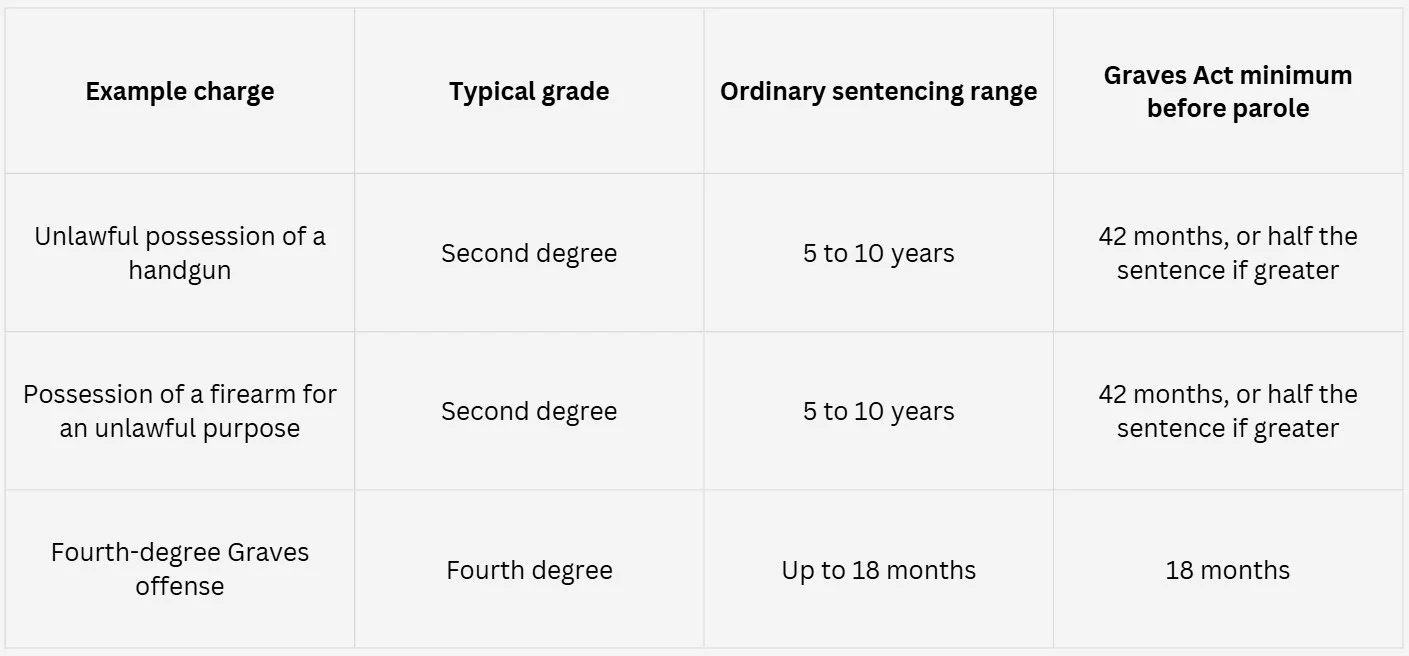
A second Graves Act conviction is even more serious: the court must impose an extended term of imprisonment. A conviction can also bring lasting consequences beyond prison, including a permanent criminal record, loss of firearm rights, and immigration and employment problems.
What Is a Graves Waiver?
A Graves waiver is a request, made under N.J.S.A. 2C:43-6.2, to set aside the Graves Act mandatory minimum when imposing it would not serve the interests of justice. It is often the single most important tool for a first-time gun offender in New Jersey.
Key features of the waiver process:
- The prosecutor must agree. The prosecutor must move for it, or approve it, before the Assignment Judge (or a designated judge).
- It is generally limited to first-time Graves offenders. A person with a prior Graves Act conviction is not eligible.
- It offers two possible outcomes. The court may reduce the parole ineligibility term to one year, or it may impose probation, which can include up to 364 days in county jail as a condition.
- The judge has a role. Even after the prosecutor moves for a waiver, the judge decides whether to grant it and which alternative sentence fits the case.
If the prosecutor refuses to move for a waiver, the defense can challenge that refusal. The Assignment Judge can review the decision, but the standard is demanding: the defense generally must show the prosecutor's decision was a patent and gross abuse of discretion or arbitrary. That is why the strength of the waiver request matters from the start of the case.
How Rigden Lieberman Mignogna Pursues a Graves Waiver
A successful waiver request is built, not simply requested. We focus on the factors prosecutors and judges weigh most heavily.
- Challenge the stop and search. If police violated your constitutional rights, a motion to suppress may eliminate the firearm evidence altogether.
- Analyze the charge. We examine whether the facts actually support a Graves Act offense or a lesser charge.
- Present the whole person. We gather proof of lawful ownership, permits, employment, family responsibilities, community ties, and character letters.
- Apply the Attorney General's guidance. Where it fits, we show the prosecutor how your case matches the circumstances the Directive identifies.
- Negotiate early. Waiver and PTI discussions often go best before indictment, when prosecutors have the most flexibility.
- Seek review when warranted. If a waiver is unfairly denied, we evaluate a challenge before the Assignment Judge.
Talk to a New Jersey Graves Act Defense Attorney Today
A Graves Act charge puts your freedom, career, and future at risk, but the outcome is not decided at arrest. The sooner you have an experienced defense team, the more options you may have to pursue dismissal, PTI, a downgrade, or a Graves waiver.
Contact Rigden Lieberman Mignogna today to schedule a consultation about your New Jersey gun charge.
This article is for general informational purposes only and is not legal advice. Reading it does not create an attorney-client relationship. Laws and prosecutorial policies change, and every case depends on its specific facts.